
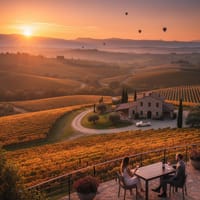
The Vine as Compass
How wine transforms travel into pilgrimage — the world's most extraordinary vineyard journeys and the landscapes that shaped them
There is no better reason to travel than wine. It draws you to landscapes of rare beauty — the steep schist terraces of the Douro, the luminous chalk hills of Champagne, the ancient volcanic soils of Santorini — and it connects you to living traditions that have endured for millennia. Wine travel is not tourism; it is a form of deep cultural immersion.
The classic grand tour follows the great appellations of France: Champagne in the north, its maisons offering cellar tours that descend into kilometres of carved chalk tunnels; Burgundy's Route des Grands Crus, running through villages whose names read like a litany of wine's highest achievements; Bordeaux and its architectural splendors, the Médoc's neoclassical châteaux set among vines that stretch to the horizon.
Yet it is often the less-traveled routes that reward most fully. The Mosel's breathtaking river bends, each dramatic curve revealing ancient vineyards cut into near-vertical slate cliffs. The Wachau in Austria, a UNESCO World Heritage valley where Riesling and Grüner Veltliner achieve a mineral intensity unmatched elsewhere. Portugal's Alentejo, where cork oak and olive share the land with Touriga Nacional vines.
New World wine travel offers its own rewards. The highway north through Napa Valley has its clichés, but venture into Howell Mountain or Spring Mountain and the clichés dissolve into something genuinely remote and wild. Chile's Maipo Valley, backed by the Andes, achieves a drama no European wine region can match. Argentina's high-altitude Luján de Cuyo, at 1000 metres above sea level, is as alien and compelling as the moon.
Travel with wine as your guide, and the world reveals itself in extraordinary detail.
“Travel with wine as your guide, and the world reveals itself in extraordinary, intimate detail — its geology, its history, its most generous human traditions.”